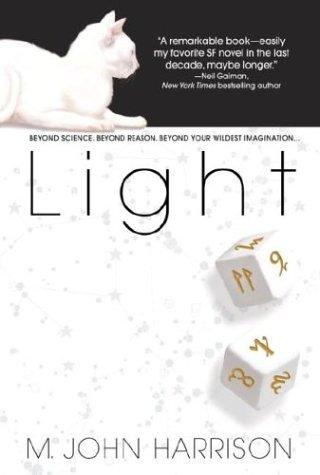
Somebody described Harrison’s style to me as a coloring book, he draws the outlines and you fill in the rest from whatever you bring to it, and that’s exactly right and exactly why this book took me two attempts to finish. Three storylines run in parallel: a washed up physicist in roughly the present day who has just murdered someone in the opening pages, and two threads four hundred years in the future orbiting the Kefahuchi Tract, a naked singularity that breaks every theory of physics any spacefaring civilization has ever had. None of it gets explained on any normal schedule. You’re told a K-ship exists and does something, and that has to be enough for the first two thirds.
What kept me reading through the confusion was the prose itself, which is doing something genuinely strange with rhythm and punctuation, sentences that make you slow down and reread not because they’re dense with information but because the phrasing itself is doing work. I went in cold and I’d actually recommend the opposite: a reader mentioned brushing up on gravitational singularities and the cosmic censorship hypothesis before starting, and having finished it, that’s not bad advice, it won’t unlock the plot but it’ll cut down on the moments where you’re completely adrift.
The future sections, especially the ones following a burned out pilot named Ed Chianese who’s addicted to a virtual-reality tank, are where the book earns its space opera billing, all cyberpunk grime and bizarre alien tech markets. The present day murder plot is the weakest of the three threads, thin motivation, a resolution that felt too neat against everything else going on around it. Four stars instead of five because of that imbalance, and because I’ll be honest, there’s a stretch in the middle where I genuinely lost the throughline and had to backtrack twenty pages. Still, the ending, Chianese flying straight into the Tract asking which button starts the music, is one of the best final images I’ve read all year.